
How to Break Into US Big Law as an Australian Lawyer
Thinking about swapping Melbourne or Sydney for New York? Here’s what Australian law students and lawyers should know about visas, the Bar, salaries and making the move into US Big Law.
For Australian lawyers, working in the United States can sound like one of those career paths that is technically possible but almost impossible to navigate. Between US Bar requirements, visas, different legal systems and the notoriously competitive Big Law recruitment process, there are plenty of hurdles.
Australians have one major advantage: the E-3 visa.
Here’s a breakdown of what the pathway can look like.

Step One: Getting a US Work Visa
For Australians hoping to practise law in the US, the E-3 Specialty Occupation Visa is often the most relevant option.
Created specifically for Australian citizens, the E-3 allows Australians to temporarily live and work in the United States in a professional role requiring specialised qualifications.
Why the E-3 matters
The visa is available exclusively to Australian citizens, with up to 10,500 places available each US fiscal year.
It is generally issued for up to two years at a time but can be renewed, making it considerably more flexible than many other US employment visas.
To qualify, you will generally need:
Australian citizenship;
a legitimate US employment offer;
the required academic or professional qualifications for the role; and
a position that qualifies as a specialty occupation.
You will still need a US employer willing to support the application, but for Australians, the E-3 can make sponsorship significantly more straightforward than the pathways available to many other foreign lawyers.
E-3 vs H-1B
You may also hear about the H-1B, one of the best-known US professional work visas.
Both visas can cover professional occupations requiring tertiary qualifications. However, the E-3 is reserved for Australians, while the H-1B is available to applicants from all nationalities and is subject to a much broader pool of applicants.
For an Australian lawyer, this makes the E-3 one of the most valuable tools available when approaching US firms.
Step Two: Can an Australian Lawyer Take the US Bar?
This is where things become slightly more complicated.
There is no single “US Bar”. Admission rules are determined state by state, meaning your Australian law degree may be treated differently depending on where you want to practise.
Some of the more relevant jurisdictions for internationally qualified lawyers include:
🗽 New York
New York is one of the most common destinations for foreign-trained lawyers, particularly because of its enormous corporate legal market.
Foreign qualifications are assessed for educational equivalence. Depending on your degree and legal education, you may also need to undertake additional study at an ABA-approved US law school, commonly through an LLM.
🌴 California
California also provides pathways for foreign-trained lawyers, although additional US legal education or other requirements may apply depending on your qualifications and admission history.
⭐ Texas
Foreign-trained applicants may need additional legal education at an approved US law school and must satisfy the jurisdiction's specific eligibility requirements.
🏛️ District of Columbia
DC can also provide a pathway for internationally educated lawyers, although foreign legal qualifications must meet prescribed educational requirements and be assessed by the relevant authorities.
🌲 Washington
Australian lawyers may similarly be required to complete additional education through an approved US law school or satisfy alternative eligibility criteria.
Remember: never assume that qualifying in one US state automatically allows you to practise everywhere else. Always check the current rules of the relevant state Bar authority before planning your pathway.
Should You Take the Bar Before Applying to US Firms?
If you are eligible to do so, it can be a major advantage.
Being Bar-ready removes one regulatory hurdle for a prospective employer and can make you easier to hire.
That does not mean you must sit the Bar before contacting firms. Some lawyers secure a position first and then prepare for the exam, with certain firms assisting with preparation courses, examination costs or study leave.
The Bar exam itself requires serious preparation. Candidates commonly spend weeks studying intensively before sitting the exam, which is offered at designated times during the year.
What Happens to Your Australian Experience?
This is one of the biggest considerations for lawyers moving laterally to the US.
Australian legal experience is valuable, but firms may not recognise it on a strict one-for-one basis because you are transitioning into a different legal system.
If you are relatively junior
A lawyer with around two years of Australian experience may enter the US market at a more junior associate level.
While this can technically mean moving “backwards” in seniority, US Big Law compensation can still make the move financially attractive.
If you have around three to four years' experience
This can be a sweet spot. You have enough transactional and professional experience to demonstrate your value while still being junior enough to adapt to the US system and firm structure.
If you are significantly more senior
Moving can become more complicated.
US firms often operate an “up or out” model, with associates approaching major career decisions around the senior-associate years. Firms may therefore need to consider where an experienced Australian lateral fits within their partnership track.
That does not make the move impossible, but your practice area, client exposure and ability to transition into US work become increasingly important.
Let’s Talk Salary…
One of the biggest attractions of US Big Law is its highly standardised associate pay system.
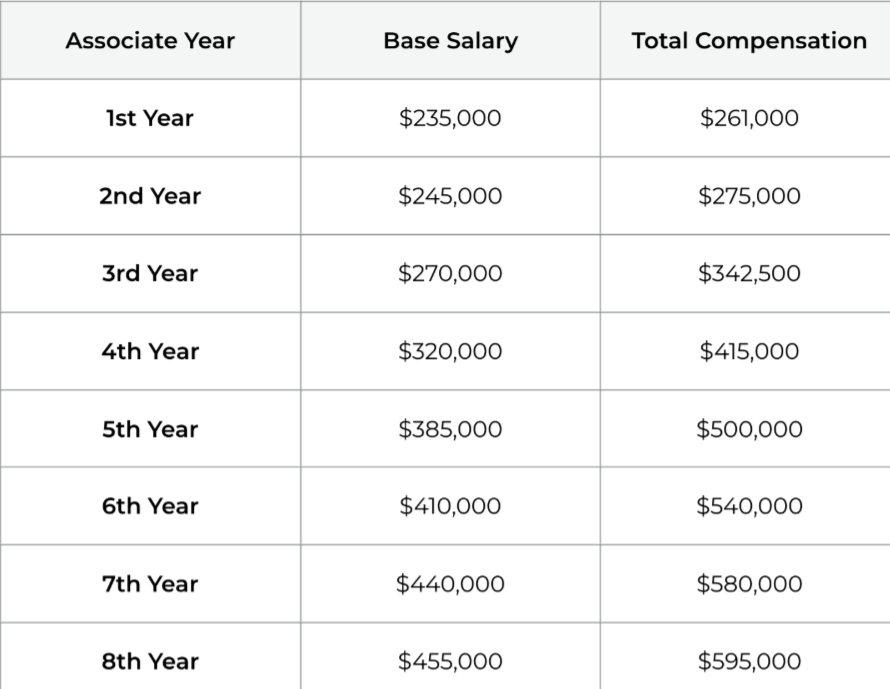
Many major firms follow a market salary scale for associates, with compensation increasing according to seniority. Bonuses can push total compensation considerably higher.
Based on the 2026 Cravath-style market scale referenced in our research, compensation at leading firms can look approximately like this:
*Total compensation can vary significantly depending on the firm, bonus eligibility, performance and the prevailing market.
The trade-off, unsurprisingly, is the workload. US Big Law is famous for demanding hours, intense client expectations and high billable-hour targets.
So yes, the salary is enormous — but firms are definitely getting something in return.
Can You Move Between US States Afterward?
Potentially, but your Bar admission matters.
US firms must comply with the professional admission requirements of the jurisdictions in which their lawyers practise.
For example, if you are hired to work in a firm's New York office, the firm may expect you to become admitted to New York.
Moving later to another state could therefore mean sitting another Bar exam unless that jurisdiction allows admission through reciprocity, transfer or “waiving in” based on your existing qualifications and experience.
In other words, when choosing where to qualify, think beyond your first job.
Which Practice Areas Travel Best?
Not every area of Australian law transfers equally easily into the US.
Australian lawyers working in transactional and internationally focused practices often have a stronger foundation for making the move.
Some of the most transferable areas include:
Mergers & Acquisitions
Large corporate transactions frequently involve multinational clients and familiar deal structures.
Private Equity
US firms have enormous private equity practices, making relevant transactional experience particularly useful.
Debt and Leveraged Finance
Banking and finance experience can translate well into US corporate practice.
Energy & Infrastructure
Energy and major infrastructure work continues to provide opportunities for lawyers with specialised transactional experience.
By comparison, areas heavily dependent on Australian legislation, procedure or government structures may be more difficult to transfer directly.
Bar Exam
US law firms generally cover the bar exam cost and the course preparation fees through a recommended provider such as BARBRI.
Lawyers will start work with a US law firm and then take leave to sit the exam. This is two weeks of paid leave and two weeks of unpaid leave for study. The exam happens twice a year in February and July.
Preparation for the Bar exam includes learning a high volume of material.
Some firms prefer lawyers to do the exam before they start work and therefore coordinate start dates around the February and July exam sittings so the lawyers can start work after having sat the Bar.
However, if you take the Bar before applying to firms it will make you an attractive international candidate. This is because employers would prefer if you have already sat and passed the Bar, as it means that they don’t have to cover the cost and you are ready to go from a regulatory standpoint.
Overseas Recruitment Agencies
1. Robert Walters
This is a global recruitment consultancy with a strong focus on placing professionals in law. Their US recruitment services are tailored to find lawyers from overseas, such as Australia, to meet the growing demand in US firms.
Robert Walters has offices in New York, Los Angeles, and San Francisco and they have connections with top-tier US law firms.
The agency focuses on placing lawyers in law firms and in-house legal roles. They work closely with international and US-based law firms that seek lawyers with specific expertise in corporate law, intellectual property, litigation, and regulatory compliance.
The agency assists Australian lawyers in understanding the US legal industry, such as the Bar requirements, salary expectations, and work culture.
The agency provides advice in interview preparation, CV optimization, and negotiations on employment terms. The aim is to ensure a smooth transition for overseas candidates entering the US legal market.
2. Michael Page Legal
This is a global recruitment agency specializing in placing legal professionals across a variety of sectors, including private practice and in-house legal roles. They provide specialized services to both US-based and international lawyers, including those from Australia.
Michael Page Legal operates in New York, Los Angeles, and Chicago. The agency specializes in recruiting for Australian lawyers in finance, technology, healthcare, and energy. They work with junior associates to senior partners, and corporate counsel positions.
Michael Page Legal guides candidates through visa requirements, US Bar exams, and other legal market entry barriers. They work closely with top US law firms, including both large multinational firms and mid-size boutique firms.
Moreover, they also offer candidates comprehensive recruitment services, including personalized career advice, assistance with resume writing, interview preparation, and guidance through the negotiation of offers and contracts.
So, what's the best path?
For an Australian law student or junior lawyer dreaming of US Big Law, a simplified pathway could look something like:
Australian law degree → Australian admission → relevant commercial experience → investigate US state Bar eligibility → secure US firm opportunity → E-3 visa → US Bar admission → welcome to Big Law.
There is no single route, and your options will depend heavily on your qualifications, level of experience and chosen state.
But compared with many international candidates, Australians have a genuinely useful advantage through the E-3 visa. For lawyers with strong commercial experience, the jump across the Pacific is far from impossible.
